
Courage Under Fire — Ryan's Story
Courage Under Fire — Ryan's Story
By Nonjabulo Mlangeni
In the latest blog on our website, we profile Ryan Crichton, a fire department chief on the East Coast. Ryan discusses his path to diagnosis, his fatherhood journey, and the rare complication he's experienced as a result of testosterone. A powerful story about endurance and the rewards of pressing on.
Ryan Crichton is living proof of what happens when you endure. Today, he's the chief of his local fire department, having spent the last two decades making his way up. But before that, he was just another kid in a classroom, feeling challenged and uninspired.
In grade school, he struggled with reading and writing, though he didn't know he had dyslexia at the time. Being in a rural area, the school had limited resources and didn't provide the necessary support.
He remembers testing out of his remedial reading program, not because he'd actually improved but because the teacher helped him pass. "The last person who cleared me basically gave me the answers," he recalls.
"I read a passage and had to answer questions about it. I'd circle an answer, and she'd say, 'try again.' Then I'd circle another, and she'd say, 'not that one.' So, I was really guessing the entire time ... they kind of pushed me through and said nothing was wrong."
Although Ryan did need extra help, he was in a better position than others. With limited staffing and a shoestring budget, the instructors seemed motivated to focus on children with serious developmental issues. Kids with more standard learning disabilities were not as high of a priority.
Looking back, Ryan believes he could have tried harder. Beyond the reading-heavy subjects that he loathed, he showed some promise in math and science. But his heart just wasn't in it. Though he didn't apply himself at school, he did stick with it, not knowing it would soon change his life.
Into the Fire
"One day, in gym class, a bunch of kids were discussing a car accident they'd seen the day before. How this truck driver had lost a hand, and all this other stuff. I said, 'what are you guys even talking about?' And they said, 'we're in the fire department, and we went on a call last night.'"
Ryan discovered that his town had a junior volunteer firefighter program, which kids were eligible to join at 15. They were trained under firemen and tested to qualify as emergency medical technicians (EMTs). Once approved, they could go on calls, provided they maintained a C average at school.
"I joined on my 15th birthday. There were 4 fire departments in my town, and I chose the one closest to home. I loved it from the beginning."
Resisting the Shame
The fire training proved much easier than the EMT qualifications. Like many men with XXY, Ryan was more of a visual or practical learner. If he saw something done, he could do it, but written exams were a stumbling block. The EMT class was the hardest he'd ever taken.
"I had to go to special classes and refreshers in-between and get some help from the people who taught me," he says. "Book work was always tough for me, but when we'd sit in class and practice taking blood pressure or doing the physical exam, I'd pass with flying colors."
Though he aced the practical portion, it took four attempts to pass the written one. I ask how he kept himself from internalizing those failures. It's easy to treat them like a footnote and focus on the eventual victory. But it takes heart to press on after multiple losses, and resist the shame that tries to creep in along the way.
"Something I say now is that I like to fail every test at least once before I pass it," Ryan says with a smile. Then he gives me the serious answer.
"I'm not really someone that gives up ... my parents have been together 40-something years, and had a strong relationship all that time. They always told us: 'you don't give up; you try your hardest ... and even when you fail, take it as a learning moment, and figure out the best way to get through.'"
The Time of His Life
The pressing paid off. By 16, Ryan was qualified to serve in both the fire and emergency services. The next two years were the time of his life.
"It was a major adrenaline rush, which I love," he says. "You could be at home in bed or in a class, and the pager goes off. It startles you every time, because you know you've got to [rush], and you don't know whether it's a car accident or a fire or what."
"Being special responders, we had dedicated parking spots at the school, so we could run out to our cars. We'd jump in, turn on our lights, and go to the firehouse to grab our gear or rush to the scene of an emergency. The whole way there, you're thinking about what's happening and making a plan. Then you get there, and nothing's according to plan. It's never the same."
Today, Ryan credits his love of adrenaline to that fire department in his hometown. But it's so much more than that. This period of his life taught him to be adaptable and to keep things in perspective.
"It made me feel comfortable with difficult situations," he says. "Because they don't seem as difficult when compared to ones that we've been in [on the job] ... today, I can think on my feet and I don't mind change."
At 18, Ryan finished high school and transitioned to Firefighter 1 status. As he rose through the ranks, he gained qualifications, even attending the National Fire Academy in Maryland.
"I became a fire officer and then a lieutenant. I did that for five years, then became captain, which I did for five years also. I just kept moving up, and eventually became the department chief in 2016."
Diagnosed at 34
During a routine physical for work, Ryan failed a spirometry test, which is a standard exam used to check lung function. He was told to see a specialist, who found his testosterone level was just 21. Though it was unexpected, the finding made sense.
"I'm 6 feet tall, and I weighed 150 pounds for several years. I couldn't put on weight and had almost no body hair. I was also an anxious mess from the time I was a kid. I'd have anxiety attacks and the only place where I didn't feel anxious was at the firehouse."
With his testosterone being particularly low, Ryan had also been dealing with serious brain fog for some time. He started testosterone therapy, but was referred for further testing, since doctors didn't know the root cause.
At a cancer center at Yale, specialists found a small pituitary tumor. Thankfully, it was non-cancerous, but they couldn't remove it until it grew. He was advised to do annual MRIs to monitor the situation until it was time to operate. Since he was taking every test imaginable during this time, he also learned that his sperm count was zero.
At first, it wasn't clear if the tumor was causing the low testosterone and infertility. As a result, it took another two years for him to be diagnosed with Klinefelter Syndrome. It was jarring to hear that he was unlikely to conceive. He'd hoped the infertility was a temporary issue that could be resolved.
"Before the diagnosis, they'd put me on Bromocriptine for a while, to try and increase the sperm count, but it never worked ... After the diagnosis, I was definitely upset. It really bothered me, because I'd always wanted to have kids. I was disappointed [to learn] that it wouldn't happen naturally."
Testosterone Complications
Since Ryan was already on testosterone when he was diagnosed with XXY, there wasn't much else to do. He'd started with intramuscular injections and seen positive changes. The anxiety disappeared, along with the brain fog. It was easier to focus and to remember things he couldn't before. He also gained a little weight and grew some facial hair.
There were also unexpected changes. He developed a skin disease that doctors connect to the testosterone.
"Between the specialists at Yale and my skin doctor here at home, I've learned that most people with XXY have higher testosterone levels than what I had. Since mine was always so low, they think it was a shock to my body when it went up and that this caused Hidradenitis suppurativa."
Hidradenitis suppurativa, or H.S., is an inflammatory condition that causes painful abscesses under the skin. It can be moderate or severe. In Ryan's case, it started out mild but worsened to level 3. A year ago, he had to have surgery on the right side of his scalp.
"It was pretty minor in the beginning. I had a tiny spot near the occipital bone at the back of my head. I started going to the doctor and they started injecting things into it, then it just spread."
At its worst, the pain was an 8 or 9 on a scale of 10. Thankfully, a medication change brought that to an end. Ryan also switched from testosterone shots to AndroGel. The H.S. symptoms are less severe now, but when he stops taking medication, it flares up again.
There have also been other serious health issues, caused by the medicine he took before this latest regimen. But you wouldn't know it by looking at him. I ask how he manages to show up in kindness and warmth, despite what he's been through. In true form, Ryan gives the credit away.
"I went to therapy and talked to them about it a lot," he says. "I'm remarried now, and my wife is really good, very supportive. So, I just feel like family is usually what helps me through. My family, and then my firehouse family, too."
Full Circle
Six months ago, Ryan became a dad. He was already a proud stepdad, since his wife has a son from a prior relationship. Together, they decided to start the donor process, and what followed was nothing short of a miracle.
"It didn't work the first few times. I think we did 3 or 4 rounds of IUI (intrauterine insemination), then we did IVF (in vitro fertilization) twice. And, because of insurance, we only had one more shot. So, we decided to switch donors. My wife had just two embryos left to use, and it worked on the last try."
It's almost poetic. A last-minute win for the man who's always been willing to try one more time. Now, he's father to a preteen and an infant. He's always wanted two.
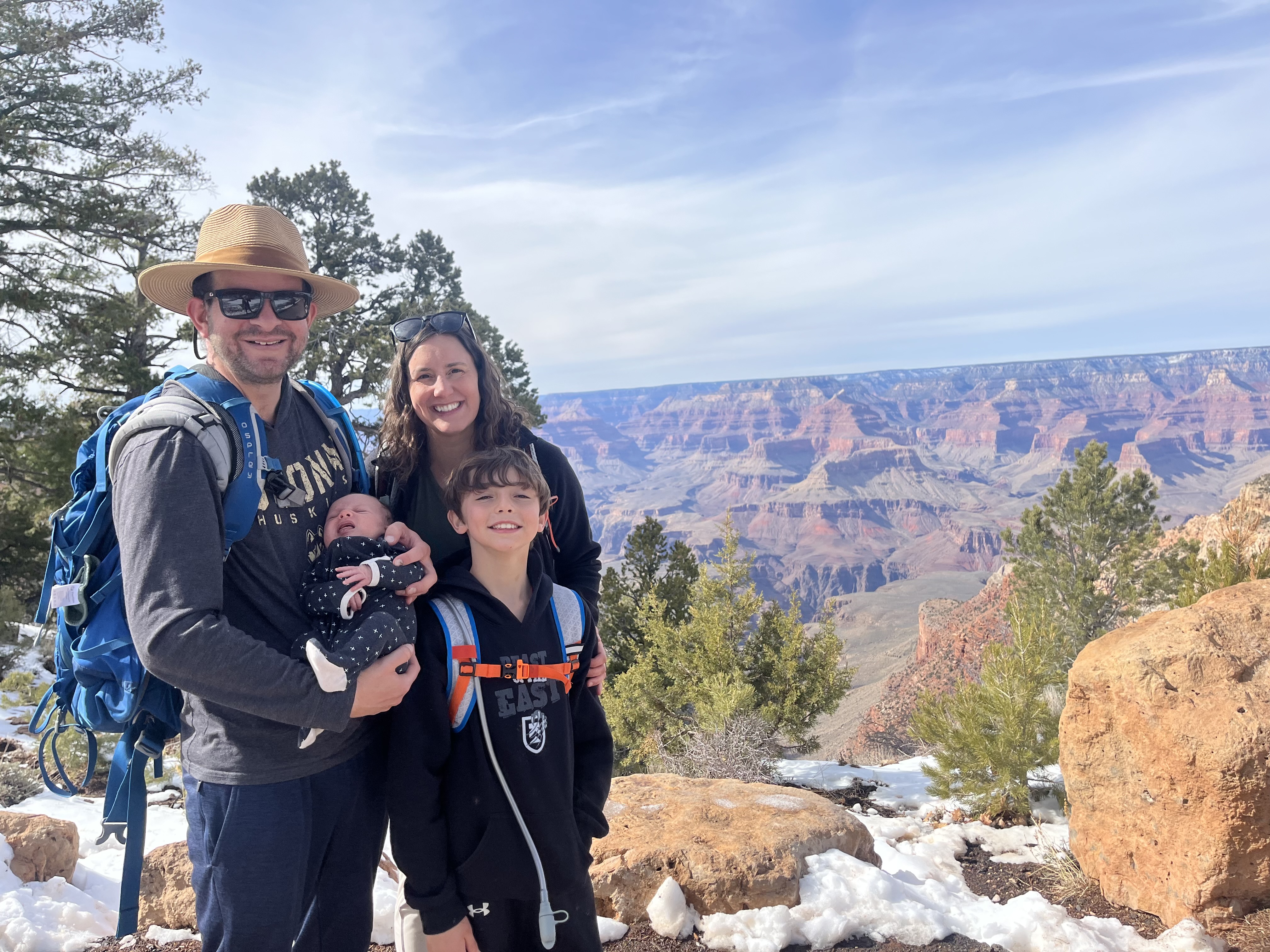
Ten years ago, Ryan and his sister were at the Grand Canyon, watching a man climb out with a baby strapped to his chest. To Ryan, that scene symbolized everything he wanted so badly for himself. "I looked at her and said, 'I wanna be that guy someday.'"
It was a moment he never forgot. Then, a few months before this interview, life came full circle, sweetly and suddenly.
"My family went out West and ended up driving to the Grand Canyon," says Ryan. "And we made it happen. I was able to hike the Grand Canyon with my baby."