
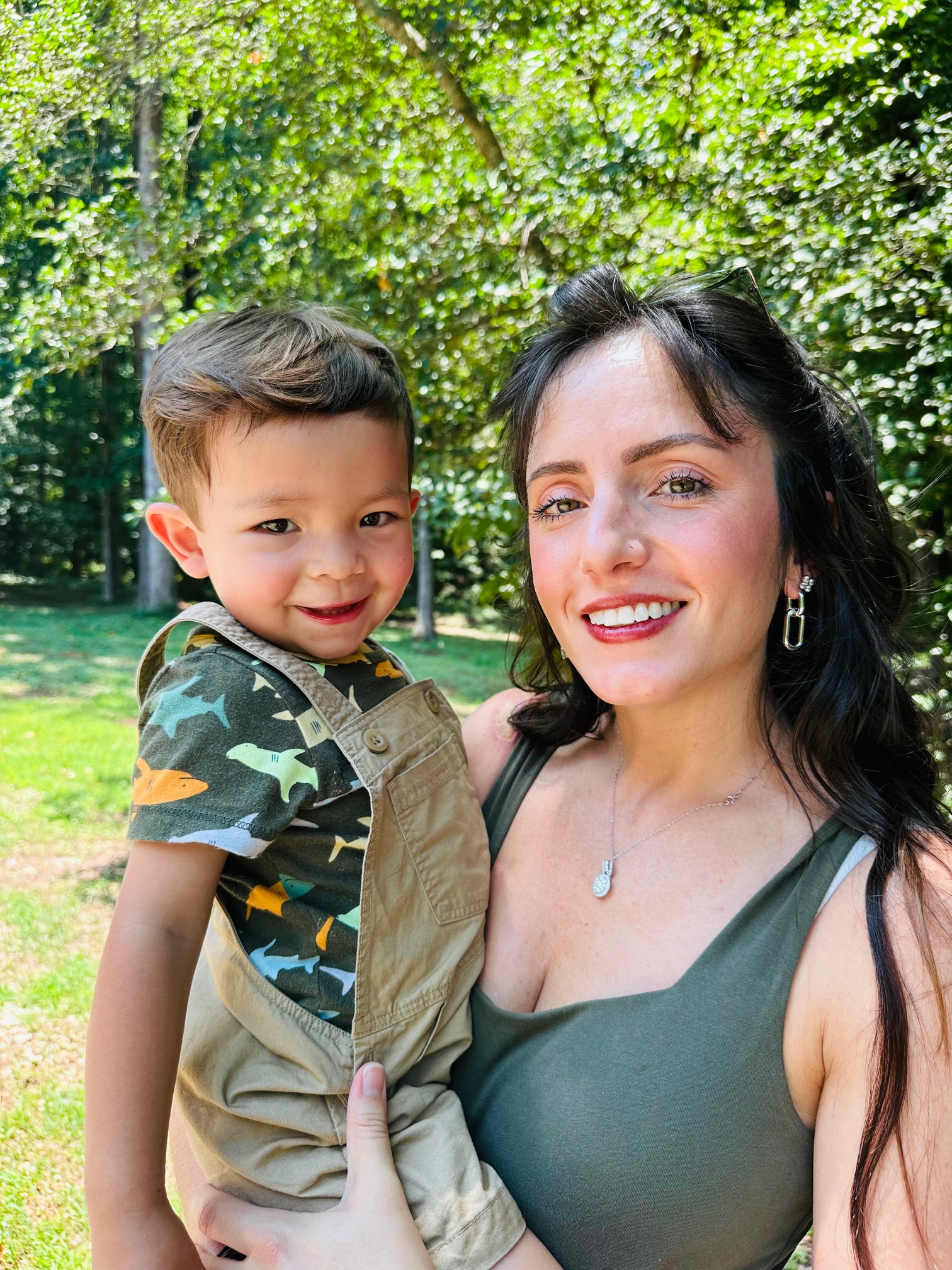
Faith and Family: Lacey's Story
Faith and Family: Lacey's Story
By Nonjabulo Mlangeni
In our latest blog, we profile Lacey Miranda, a vibrant mom of five whose youngest son has Klinefelter's. From receiving the XXY news in utero to parenting her rambunctious little boy, she shares what the last few years have taught her and why she's so glad she brought baby Jack into the world.
In late 2021, Lacey Miranda was early in her pregnancy and eager to know the sex of her child. Instead of waiting to get a gender ultrasound at the 20-week mark, she and her husband opted for noninvasive prenatal testing (NIPT). It was only in the weeks after the gender reveal that she examined the results herself and noticed something unusual.
"There was a red exclamation mark with the words 'high risk,' but it didn't clearly say what for. I'm in the medical field myself, but the wording wasn't easily digestible to me. I was alarmed, since it had been weeks and nobody from the OBGYN's office had called."
She quickly called the nurse line, and a doctor called her back—extremely apologetic. Through some oversight on their end, Lacey had essentially stumbled upon the knowledge that her son was at high risk for Klinefelter's. And while her medical team was supportive, they weren't exactly experts in the area.
"They walked me through it, but barely," she remembers. "XXY is something a lot of people aren't educated on."
The news seemed to settle over Lacey like a fog. And since she found out so early in her pregnancy, she spent much of that time in mourning. Many parents that receive this news experience a peculiar kind of grief. There's a sense of loss, without fully knowing what you've lost.
In truth, you're grieving the hope that your child would be perfect. Not because you need perfection, but because you know that being different often makes life tougher. The diagnosis feels like one more burden they'll face in an already hard world.
Facing the Unknown
Lacey was desperate for credible information that could help her understand what her family was facing. One of the first things she did was consult specialists about getting an amniocentesis, which would provide more accurate results. But she was told there was no point in further testing if it wasn't going to change the outcome of her pregnancy.
While doctors say such things to be pragmatic, these statements carry more weight than they think. The early days of an XXY diagnosis are a vulnerable, confusing time. Many parents just want to know what they're dealing with. But in their search for clarity, they're often nudged toward abortion, which is presented as their best option.
"I was like 'well, I'm not getting an abortion, so I guess we're not doing an amnio," Lacey says. "I saw them once, and after that I said I'll just do my own research and start figuring things out."
So, she rolled up her sleeves and got to work. And like many parents do, she learned that googling Klinefelter's is not for the faint-hearted. Much of the content focused on the most severe cases, and many support groups focused more on pain points than encouragement. It was hard to find anything that offered a balanced perspective or even a glimmer of hope.
"What you see on the internet is just awful, until you find something like Living With XXY, where you're not just reading about the negative aspect of things. This was the only positive perspective that I could find during my pregnancy."
Lacey took comfort in reading stories about people that were living well despite their XXY. Getting a glimpse of their day-to-day reality helped calm her fears about the quality of life her own child could have. It also helped her develop realistic expectations. After all, the knowledge gap is often the hardest part of a Klinefelter's diagnosis.
"If I'd heard my kid had Turner Syndrome or any of these more [known] issues, I could find a lot more information about what life would look like," she says. "But with XXY, there's so little information and so little accurate information. So, it's the grieving ... and the fear of the unknown. Because you're like, 'what does this mean for me?' and nobody can tell you. They're still finding stuff out."
When I ask how she came out of grief, Lacey credits her husband, whose support helped her start living again. From an emotional perspective, she also got swept up by the euphoria of having a newborn. With everyone around her celebrating life, it was hard not to return to a place of joy.
Meeting Milestones
For the first year after little Jack was born, the couple kept the diagnosis to themselves. It was important to them that people got to know him for who he is instead of labelling him. In terms of development, she found that Jack needed help during key moments of transition, as opposed to ongoing support.
For example, he did the most physical therapy during the period when he was going from crawling to walking. Beyond that two-month stint, he mostly did single sessions when it was time for him to master a new milestone, like learning how to sit.
"It's like he couldn't figure out how to do it on his own. So, having the therapist teach him that skill by walking him through it [was enough]. He just needed to be shown."
So far, Jack has not needed speech or occupational therapy, but Lacey is mindful that he could need some accommodations as he gets older and starts school. For now, she takes full advantage of the resources available to her and implores other parents to do the same.
"I have a prevention mentality, [so] before I even see a problem, I want to make sure we have everything we need. I want to be his biggest fan and his biggest advocate, so I push to have him evaluated by professionals who know what they're doing. If they say that he's where he needs to be then I know I've done my job as a mom."
She tells parents not to be scared to dig deep in their research, especially when it comes to finding the best centers and doctors near you. That's how Lacey found the specialist Jack sees today.
"Instead of doom scrolling on social media, I was always researching XXY ... then I found her information through some random article. She's one of the leading researchers in sex chromosome abnormality, and she heads The eXtraordinarY Clinic in Atlanta. I emailed her before Jack was even born and said, 'I want to get my kid in to see you.'"
Keeping the Faith
As Jack turns 3 years old, Lacey reflects on how much more information has been made available in recent years. It gives her hope that future parents will have an easier time than she did. For her part, she's come to terms with the fact that there's only so much she can do right now.
There are future conversations they must have with Jack about puberty, fertility and whatever else may come. She prays ahead of time, asking God to give her wisdom in those moments, and help her say what needs to be said.
All in all, Lacey has a sense of peace; she also finds deeper meaning in everything that's happened. "My child is here, and there's not one thing I would change about him. He's the definition of perfection. He's the light in the room, he's full of joy and happiness ... I tell people that God knew exactly what I needed when He gave me him."
When I ask her how she'd encourage other parents, she tells them to keep their eyes on the bigger picture. "Don't let the diagnosis define your child," she says, then pauses for a moment. "Now, this one's hard—especially if you're a first-time parent ... But try to let them just be rambunctious boys ... don't be so overprotective."
Smiling, she tells me Jack is the smallest of her boys yet runs circles around the rest. "He can keep up with the best of them ... you can't tell the difference if you don't know, so just let them be who they are."