
Growth In Motion: Ethan's Story
Growth In Motion: Ethan's Story
By Nonjabulo Mlangeni
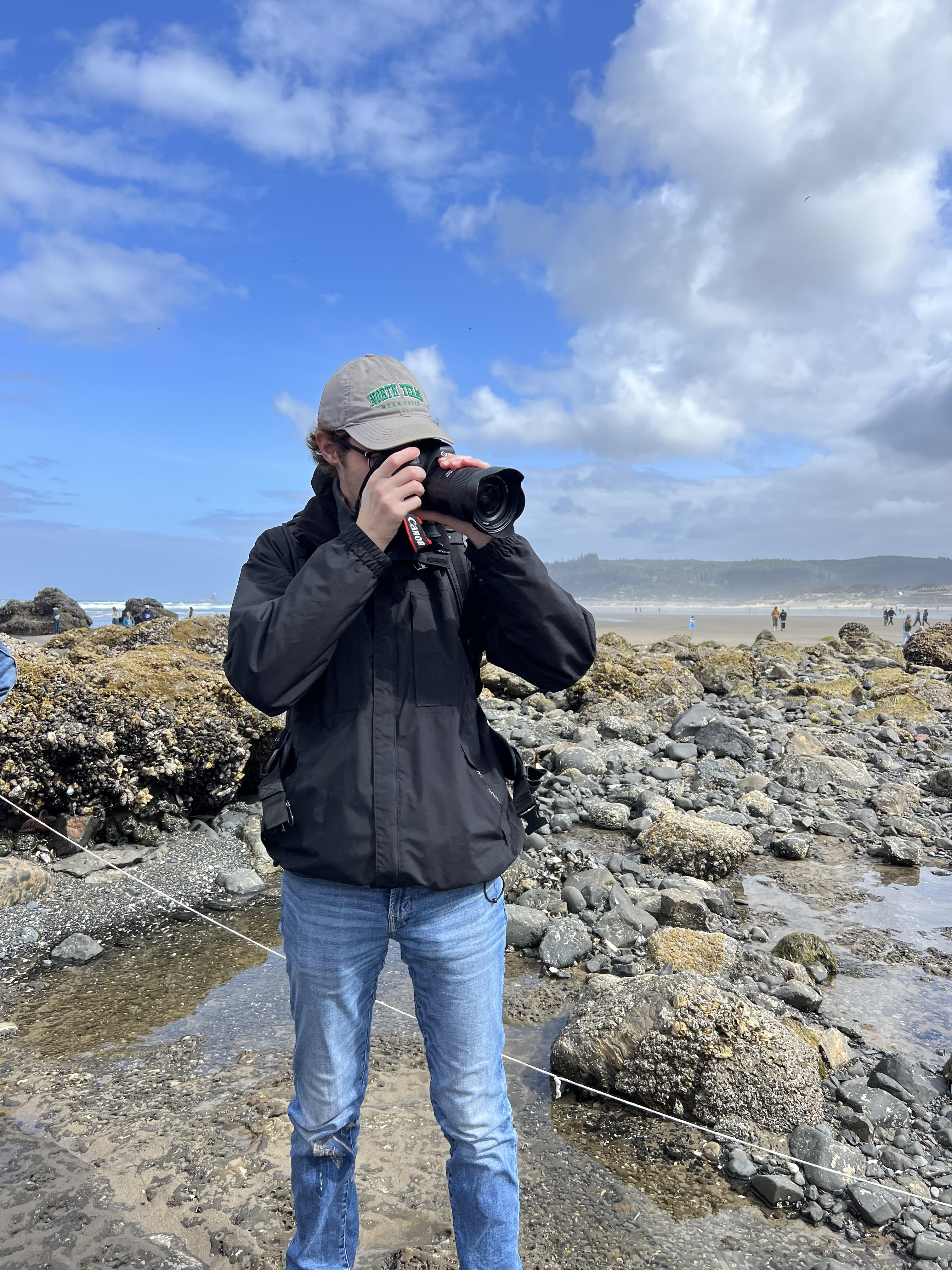
In our latest blog, we profile Ethan Hardy, a professional photographer on the Gulf Coast. Still in his 20s, he gives a young man's perspective on ambition, growth, and turning scars into strengths.
Ethan Hardy is at a watershed moment. He knows it, too. We talk about many things on our call, including the fact that adulthood is upon him. Not the arbitrary 'adulthood' of 18: when we become adults in the eyes of the law. But the real adulthood of 26: when our brains are fully formed, and we reach the point of physical and emotional maturity.
It's a season like no other. You finally know who you are—and have the time and energy to actually do something with it. But Ethan wasn't always facing a world of opportunity. There were times when the world felt smaller. More restrained.
In school, he faced learning challenges that weren't fully explored or explained. He specifically struggled with focus and retention. But when he sought more understanding of the issue, he got a broad explanation that didn't help much.
"My siblings and I were mainly homeschooled, but I got tested multiple times through the public school system. They pretty much just said 'you have extreme learning challenges and dyslexia.' I thought 'okay, I knew that already.'"
Though he struggled with subjects that required him to memorize information, he showed promise in visual, practical or creative tasks.
"Anything that was hands-on or tactile, I was almost a prodigy at. I also gravitated towards art, and things that were more picture-based. I learned very quickly that I'm a tactile and visual learner. But auditory [learning], absolutely not! You can tell me something and I'll likely forget it."
Speaking of memory, Ethan mentions that his is not the best. He has a general idea of his past experiences but can't always provide specifics. To date, he's not sure if that's related to XXY. I'm not either, but I mention that he's not the first man who's talked about having some difficulty remembering parts of his youth in detail.
Puberty and Depression
In the end, not everything merits our remembrance. High school wasn't exactly a fountain of joy. The sense of not fitting in, the bullies, the angst. It's a potent cocktail that many would rather forget.
What Ethan does recall is that things took a turn when puberty came. That's when he noticed the learning challenges and started to experience depression.
"Elementary and the period before that were awesome. I didn't see any challenges, I didn't see anything. It was in middle school and high school that it started. When puberty started, I feel like the chemical [changes] in the brain that XXY causes began to take effect."
He was a happy kid until that point. Then he entered survival mode, using most of his mental and emotional energy to get through the day. I listen as he talks about trying to "stay afloat," both academically and socially. The phrasing stands out because it speaks to a sense of living on the brink of overwhelm. One wrong move and you may drown.
"It was looking pretty bleak," he says. "Both middle and high school were extremely difficult ... for multiple reasons, not just Klinefelter's-related stuff, although that didn't help. I had people that liked me, but the issue was that I didn't like myself. And [since I wasn't diagnosed back then] I didn't have testosterone."
Today, Ethan uses testosterone not as a steroid but as an antidepressant. But since the depression started during puberty, and he was diagnosed much later, he spent many years white knuckling it. Toughing it out in the dark. In those days, and now, it's faith in God that kept his mind.
"It's imperative that you find something to put hope in. I find an unshakable God to be the best thing. I would definitely say the only reason why I actively choose to draw breath is because of Jesus Christ."
Finding Direction
Today, Ethan is a professional photographer with a degree in that field. But he's quick to note that he made it this far at his parents' insistence. Ever self-aware, he noticed in his teens that he was short on motivation. Left to his own devices, he's not sure he would have met his potential.
"I realized back in high school that I really lacked the drive or the gumption to do stuff," he says. "The only reason why I played sports, went to college and chose a degree was because my parents kind of pushed me into it. And that's not a bad thing."
His parents understood when to prioritize what was best for him over what was comfortable. Looking back, he's glad.
"I definitely needed that, or else I would've been very antisocial and very disinterested in doing these things because it was so difficult. I needed that push on the back to move forward in life."
I ask how parents can tell if they're pushing a child for their own good or simply projecting their own ideas and ambitions. He admits it can be hard to toe the line. Plus, things can vary depending on family dynamics.
In his own case, he remembers pushing back on his parents' efforts to guide him. But the XXY diagnosis eased that tension because it brought understanding to both sides.
"There were some sparks flying growing up, just like with any family. The diagnosis definitely helped with that, because [my parents] didn't know there was something up, so they were pushing me to do stuff [without understanding the deeper challenges]. But, ultimately, it's just like any other relationship. You need to make your heart known and your boundaries known."
With his parents' support, Ethan saw his education through to completion. Like many men with XXY, he had some trouble choosing a field he could enjoy and excel in. Since college classes are a heavy lift for some, they must carefully count the emotional and intellectual cost.
It's a delicate balance. Finding a learning path that's: (1) interesting enough to hold your attention, (2) makes use of your personal strengths, and (3) has coursework that won't get progressively overwhelming.
Ethan started out studying game design, but learned it only met two of the three criteria.
"It was really fun, but we didn't get any sleep. The culture and the expectation in that field is that you're working 26-hour days."
Then the COVID pandemic hit, and he had to go home. The time away helped him reflect and redirect.
"I realized I needed to switch gears and ended up getting my degree in photography. I also did metalsmithing and jewelry crafting. I really enjoyed those classes but ultimately chose photography because it earns more."
Diagnosed at 19
Though Ethan was diagnosed in his late teens, the lead-in took years. At 17, he'd suffered a groin injury while playing sports. In the aftermath, he got a physical exam, and the size of his testes prompted the doctor to do additional tests.
"We weren't even checking for Klinefelter's. We were just checking for damage because I got hit pretty hard. But they said they wanted to look into something else, and we said okay. That started a two-year process of figuring things out."
At 19, he was finally referred to a urologist, who ultimately delivered the news. As he listened, Ethan was completely detached.
"I literally felt nothing when they said it," he recalls. "I was just like, 'okay, I don't know how to process what you're throwing at me.' It wasn't until a month later that I was like 'oh wow, I have Klinefelter Syndrome.'"
Ethan's not the first man to say he felt nothing when he got the news. Some only start to process it later. He agrees that parents of adolescents or young adults with XXY may want to revisit the conversation after a little time has passed. That leaves space for the diagnosis to fully sink in.
Processing Emotions
Ethan has found that he experiences a lag when it comes to processing or even feeling emotions after he receives information.
"That's across the board for me," he says. "For example, a few years back, my grandpa died, and to me that was just information. Then, a month later, I thought 'wow, I'm actually really sad.' There's a lag on our emotions sometimes, but testosterone helps with that."
After the diagnosis, Ethan's family saw multiple urologists, looking for one that was informed about XXY and infertility.
"I went through a surgery and they took a tissue sample to see if there truly was an absolute zero percent chance for me, and it was an absolute zero. After the diagnosis, part of the depression was about not being able to [naturally] become a father."
It was a lot of life-changing information in a very short time. For Ethan, this made it hard to process. Looking back, he would have preferred to get some of it in stages.
"I kind of got firehosed and it took me about four years to emotionally and mentally process it all and get to the point of feeling okay with XXY."
Facing the Future
Today, Ethan feels alright. Testosterone has helped in ways that go beyond the physical. It's been a mood lifter, improved his focus, and increased his productivity and mental clarity. He takes it in gel form, and jokes that he'd probably be stumbling through our conversation without it.
To stay active, he prefers rock climbing, where his long and lean frame is an asset. In terms of service, he volunteers for the youth ministry at his church, where he's a leader.
He recently started a photography business and is stretching himself to meet the demands of entrepreneurship. As always, his parents are helping him to show up as his best self.
He doesn't enjoy photographing people but he loves capturing landscapes and homes. His mother's in real estate, and he helps her with the more creative parts of the business. Staging homes and setting moods through angles, spacing, and light. Using these components to tell a particular story.
Sometimes, the space will look cozy and lived-in. It's intentionally made to beckon you gently. Other times, it's less accessible and more aspirational. Curated to feel like an acquisition. A trophy for someone who loves to show. It's like creating a kind of world.
This raises a point that's come up in other interviews: how creative careers and spaces are often ideal for men with XXY. There's a freedom to be yourself and shape the world that's spent decades trying to shape you. Ethan's been creating worlds for some time, but now it's more of a tool and less of a coping strategy.
"When I was 13, and managing some hard stuff, I created a world in my brain—kind of like Narnia. And I still dabble in it a little today, but I realized I can use that as a tool to help me with my job."
This is growth in motion. As we heal, the things we once did to survive become evidence of ingenuity. Proof of skills and talents that we can repurpose for our own good. Today, the imagination that Ethan once used to escape is being used to aim higher.
"That's the reason why I became a business owner ... I wanted to be in control of my future. Not just how much I can make but even protecting myself from someone subconsciously discriminating against me because of my disability. Without even realizing it, they might put a glass ceiling on what I can do, and I want the freedom to do my own thing."