
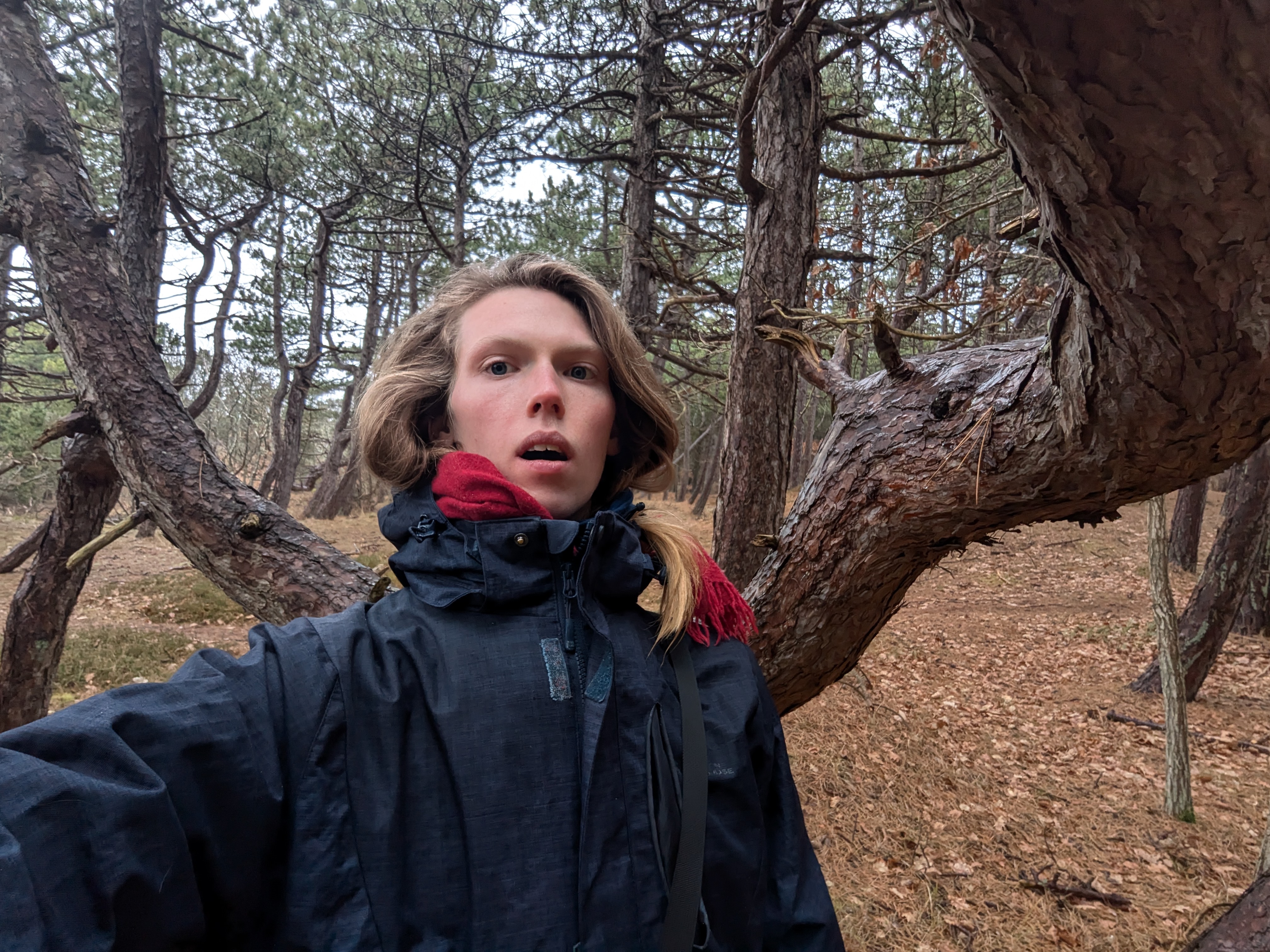
Hidden Gem: Joachin's Story
Hidden Gem: Joachin's Story
By Nonjabulo Mlangeni
In our latest blog, we profile Joachin Solvild, an enabling support worker from Denmark. Joachin was fortunate enough to receive his XXY diagnosis at 20, allowing him to undergo a successful MicroTESE operation. Still in his 20s, he shares how he's navigating young adulthood, love and relationships in this time.
When I asked Joachin Solvild for an interview, he agreed on the condition that he'd have enough time to pause and think before he spoke. It's not a common request, but it's a sensible one. And the more we speak, the more I understand.
There are things that neurotypical people take for granted. Assumptions we make about what people should be capable of, or what should come easily to them. When we ask what seems like a simple question, we expect a response in 30 seconds or less. If it doesn't come, we start to wonder if something's wrong, instead of checking our own expectations.
Those who aren't neurotypical bear the brunt of these assumptions and pay a price that we don't see. Joachin knows this dynamic well. As a child, he often felt rushed. There was a looming sense of pressure, like the world was in a hurry and dragging him on at an unnatural pace.
In class, it was the pressure to keep up, though the information seemed to come in too much and too fast. But, like many boys with XXY, he was too shy to raise his hand and felt mortified at the thought of disrupting the program. So he just pretended to know, acted like he understood.
"Just the thought of raising a hand created so much anxiety ... I felt I had to lie, like 'yes, yes, I know what you mean,' when it wasn't true. It [didn't feel] very good, but admitting the truth felt too vulnerable, and like it would be humiliating."
Some of the anxiety was caused by the group atmosphere. Joachin was always better one-on-one. He felt most like himself when he could be seen as an individual, and not judged by standards set by the crowd.
"Even in friendships, when it came to groups, I felt like I was always following what the group wanted. Going along with that instead of leading or contributing what I had in mind. But, one-on-one, I'd feel like, 'okay, we accept each other and there's a connection and it's [safe] ... I can speak up, it's more slow [paced] and it's okay.'"
Unsurprisingly, he was drawn to individual sports. Though his dad nudged him toward football, he excelled at tennis and badminton. Though he enjoyed it, he noticed that he often felt physically weak. He tired faster than his peers and had a lankier frame, which he now connects to Klinefelter Syndrome.
Diagnosed at 20
Being born and raised in Denmark, Joachin went through a different school system. Around 16, he began a one-year program, where he could focus on music, art and sports.
He enrolled at a small boarding school that specialized in those areas. It was a close-knit community, with the campus itself located on a tiny island in the countryside. In that idyllic setting, students lived and learned together, played sports and started bands.
He spent that year cultivating his creative talents, then moved back home for another three years of study—Denmark's version of high school. It was shortly after graduation that he received the Klinefelter's diagnosis.
A friend of Joachin's had become a sperm donor and told him it was an easy way to make extra cash. Being just 20 at the time, he had no shortage of hobbies to fund, and it sounded like a good idea.
"I thought 'okay, I can make easy money while doing a good deed to help someone who can't have kids.' And I just assumed everything was fine with me, then I got an email from [the bank] saying they couldn't find any sperm cells and I should see a doctor."
So he did. And after various tests and referrals, Joachin landed at a clinic in Copenhagen that specializes in chromosomal anomalies. When he finally learned that he had XXY, he had no emotional response. Instead, there was calm detachment. Being so young at the time, he wasn't even sure he wanted children. Hearing that natural conception may not be an option had no real impact.
"The doctor said, 'this is what you have, and we don't know much about it, but here's what we do know.' They had a visual aid to explain, which was good [because I'm a visual learner] ... But I really didn't know what to say. It didn't really matter to me. It was just information that I saw, and then continued with my life as if it never happened."
Resisting Testosterone
Though doctors recommended testosterone therapy, Joachin initially declined. Instead, he travelled a world away, as if to distance himself from news that he didn't know how to process.
On a solo trip to Costa Rica, he started to work through what he'd heard. Though it felt good to say it out loud, it didn't change his mind about accepting medical help. He was staying at a spiritual community, where most residents were devoted to natural remedies. When it came to the XXY, it was an echo chamber of unhelpful advice.
"I was young and really opposed to taking any medicine. I thought, 'oh they want to control me.' And this was a hippie community, so people were like 'yes, the system wants to control you; don't listen.'"
Today, Joachin recognizes that this was the folly of youth. He chuckles as he shares his thought process during that time. Ultimately, he was just trying to figure things out. Trying to understand how to process this new information in a way that aligned with his worldview at the time.
He also used this time to consider doing a sperm retrieval surgery, which was offered to him before he left home. But when he returned to Denmark, he continued to shy away from mainstream healthcare. Instead, he tried homeopathy, hoping to increase his testosterone through natural means. When that didn't work, he surrendered.
MicroTESE Surgery
"The doctors said I had to make a decision about the [MicroTESE] before I started testosterone. If I started before, it could influence the number of sperm cells they find. I ended up doing it, since I might decide that I want kids one day. They found just six sperm cells out of however many millions [there should be]."
It's been seven years since the procedure, and he's still not sure if he wants a family someday. But ultimately, he's glad to have that option. Beyond that, he now sees that it was a privilege to receive testosterone therapy relatively early, and avoid the health issues he may have experienced otherwise.
An Artist's Life
The energy surge that came with the testosterone took Joachin by surprise. He genuinely didn't know that he didn't have to go through life feeling so exhausted. The newfound vitality couldn't have come at a better time. He'd just discovered a passion for dance, and now had the energy to cultivate it. When the pandemic hit, he was in Ghana with friends, taking dance and drumming lessons from local musicians.
Around the same time, he fell in love with a woman who shared his interests. Together, they'd attend retreats where they'd sometimes dance for four hours at a time.
Today, Joachin's in a constant cycle of working and travelling. He works part time, at a care facility for people with disabilities. He feeds them, clothes them, and when time permits, takes them for activities or walks. Though he likes his job and his coworkers, he doesn't build his identity around those things.
Instead, he prefers an artist's life: working just enough to live, and to see the world.
"Where I work, I'm not a member of the main team. I can come and go as I please and plan my own schedule. It keeps me in control and lets me be free."
Despite external pressures and societal expectations, Joachin is not interested in a traditional career path. Indeed, he's never felt drawn to traditional anything. From alternative medicine to alternative therapies, he's forever intrigued by different ways to move through the world.
But how else could it be for someone who's always felt the world moves too fast? To this day, he's trying to find harmony between its expectations and his own.
Love and Intimacy
Right now, he's learning how to be in a relationship. How to handle the intimacy and scrutiny of doing life with someone else. The way that close relationships bring all of our quirks and faults to the surface. The way it sometimes feels like a relief to be alone and not have to try.
For Joachin, it's as if he got a handle on one half of his life and now has to master the other. Long-term love is a new learning curve that requires a new set of relational skills. It's shown him what he still needs to work on.
"I feel that there's a big difference in how I function in life, and how I function in relationships," he says. "Like two different worlds."
One thing that's stayed with him is the struggle to assert himself and communicate what he doesn't understand. He's still in the habit of acting like he gets things when he really doesn't, which creates conflict in his relationship.
There has also been emotional overwhelm. Some of the changes brought on by the testosterone made him feel like he wasn't himself. He's spent most of his life with a lower sex drive and considers that his natural or normal state. So when that changed, his mind didn't relate. He had a sense of being pulled in two directions.
"Your hormones switch to this place where your body wants a lot of sex, but the real me—my true self—is slower. If it wasn't for the testosterone [I wouldn't feel that way]. It felt like there were two people inside of me and the first person couldn't follow along with the new development, which affected my relationship."
Joachin finds that he feels more like himself when he takes less testosterone. It's been a long road to find the right dosage, but today he takes about half of what his doctor recommends. He's also seen a psychologist, who diagnosed him with Asperger's and ADD. This information has been helpful, because it provides a starting point for therapists who are largely unfamiliar with XXY.
Today, he's getting more support than he ever did before. Having a more "mainstream" diagnosis has also made it easier for him to help himself. He does a lot of ADD research, listens to various podcasts and is also part of a support group.
"It's been very informative, because you can't go to therapy and say you have Klinefelter's and get help. [In my experience,] nobody in Denmark knows about it. Each time I asked, they'd say they've never heard of it. So when I found out about the ADD, it allowed me to name something that they know how to tackle ... Because I'd been through therapy before, and it went nowhere."
A Hidden Gem
Today, Joachin is in a hopeful place. Though everything isn't simple or easy, he's more self-aware than ever before, and that knowledge of self empowers him. This is why the XXY diagnosis "became a relief" in the end. It's helped him put his cards on the table and make an honest assessment of who he is and what he needs.
The feeling of being flawed or unworthy is fading. In its place comes a practical understanding, and a gentle confidence that grows day by day. The person in front of me is not that kid who sat in class thinking everyone else had all the answers.
"I think that's what people experience when they have Klinefelter's ... and maybe also ADD or ADHD. But it's not that you don't know the answers or don't have the information. It's that it's latent, so it takes a while to come together in your mind and communicate with others."
Latent? I hadn't heard that word since a college psychology class. And here's the second-language speaker from Denmark, throwing it casually into the conversation. He then asks me if he used it right. I pick up my phone to Google the term, slightly ashamed that I can't recall.
Latent means present but not yet manifest. It speaks to things beneath the surface. To Joachin's point, there are people walking around with hidden potential and minds full of hidden gems. And the fact that some people can't see that doesn't make it any less true.
"Is that the right word?" he asks.
Turns out it's more than right; it's perfect.